
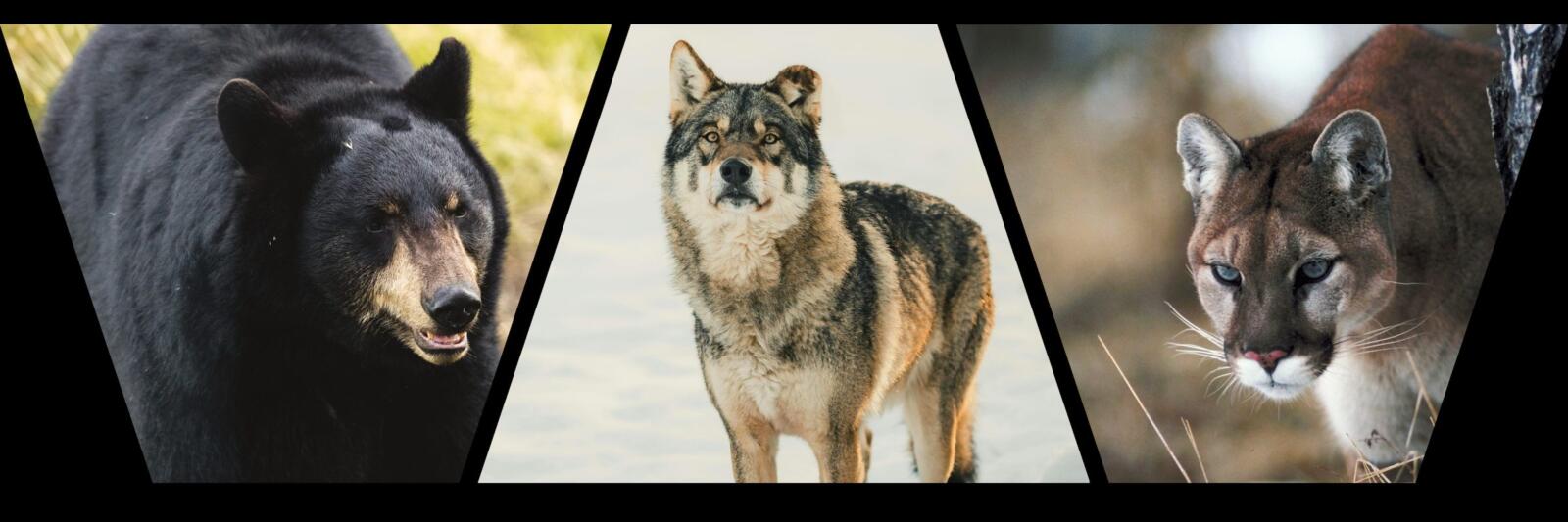
The Living with Wildlife working group met November 11–13, 2026 in the Samuel T. Dana Building at the University of Michigan in Ann Arbor, bringing together researchers and practitioners from universities, federal and state agencies, and conservation organizations.
The question
Over three days, participants examined whether resilience science, with its ideas about stability landscapes, tipping points and early warning signals, is useful for understanding how human-carnivore coexistence in the United States stabilizes, degrades or collapses. The group worked to define what would actually count as a regime shift in these systems, tested candidate criteria against real U.S. cases, and outlined the monitoring needed to detect such transitions before they happen rather than only in hindsight.
Program
- Day 1: Foundations and case framing
- Day 2: Detection, data and cross-case learning
- Day 3: Synthesis, research agenda and next steps
Cases
Participants tested their ideas against eight U.S. human-carnivore systems:
- Red wolf recovery in eastern North Carolina
- New Jersey’s black bear hunt
- Wisconsin’s February 2021 wolf hunt
- Federal listing cycles for Great Lakes gray wolves
- Colorado’s voter-mandated wolf reintroduction
- California mountain lions after Proposition 117
- Mexican wolf recovery in Arizona and New Mexico
- Cougar recolonization in Michigan
Initiative team
Neil Carter
Initiative lead, University of Michigan School for Environment and Sustainability
Interdisciplinary research exploring complex feedbacks among people, wildlife and ecosystems through field-based, quantitative and conceptual approaches. Brings expertise in human-wildlife interactions, social-ecological systems, and actionable conservation research that supports biodiversity and human well-being.
Jacob Allgeier
Co-investigator, University of Michigan Department of Ecology and Evolutionary Biology
Community and ecosystem ecology, biodiversity loss, and ecological theory in applied conservation contexts. Brings ecological theory and ecosystem-function perspectives.
Kristy Ferraro
Co-investigator, University of Michigan School for Environment and Sustainability
Ecosystem ecology and animal-mediated ecological processes. Brings expertise on animal communities, ecosystem functioning, resilience and ethical conservation.
Andy Marshall
Co-investigator, University of Michigan Department of Anthropology
Tropical vertebrate ecology, primate conservation and conservation biology. Brings broad expertise in ecological systems, biodiversity and applied conservation.
Brian Weeks
Co-investigator, University of Michigan School for Environment and Sustainability
Conservation ornithology, evolutionary ecology, biodiversity and global change biology. Brings macroecological and conservation biology expertise to resilience and biodiversity questions.
Steve Yaffee
Co-investigator, University of Michigan School for Environment and Sustainability
Environmental policy, dispute resolution, collaborative problem solving, monitoring, evaluation and adaptive management. Brings facilitation, governance and collaboration expertise.
Chiara Finelli
Initiative coordinator, University of Michigan School for Environment and Sustainability
MS student whose research focuses on how human perceptions, values and emotions shape wildlife conservation and coexistence. Brings experience in conservation communication, stakeholder engagement, and making research accessible.
Participants
Alice Bernard
University of Michigan School for Environment and Sustainability
Wildlife ecology; mammal communities, human health, and conservation in human-modified landscapes. Brings an ecological and public health perspective to coexistence and resilience questions.
Craig R. Allen
University of Nebraska
Resilience scientist; panarchy, adaptive management and social-ecological systems. Brings foundational resilience and cross-scale systems expertise.
Richard E.W. Berl
USGS National Wildlife Health Center
Research social scientist; human dimensions of wildlife health and disease management. Brings social science and wildlife health systems expertise.
Jeremy Bruskotter
Michigan State University
Human dimensions of wildlife conservation and management. Brings expertise in public attitudes, social and political dimensions of carnivore conservation, and wildlife policy.
Joseph K. Bump
University of Minnesota
Animal ecology, carnivore ecology, carrion ecology, conservation science and wildlife management. Brings large-mammal, wolf and ecosystem process perspectives.
Emily Carrollo
Panthera
Works in cougar and mountain lion conservation and restoration. Brings applied carnivore conservation and practitioner experience.
Eric Clark
Megwayaak LLC
Wildlife ecology and adaptive management at the intersection of Anishinaabe and Western science. Brings interagency management and field research experience with wolves, moose, snowshoe hare, American marten and ruffed grouse.
Mark Elbroch
Panthera
Director of Panthera’s Puma Program; puma and cougar ecology and science-based conservation strategies. Brings deep applied carnivore ecology and management experience.
Angela Fuller
New York Cooperative Fish and Wildlife Research Unit, Cornell University
Leader of the New York Cooperative Fish and Wildlife Research Unit; wildlife population ecology and applied decision support. Brings agency-facing wildlife science and management expertise.
Benjamin Ghasemi
Texas A&M University
Human dimensions of wildlife and large carnivore coexistence, including psychometric approaches to measuring coexistence readiness. Brings social science tools for understanding attitudes, beliefs and management interventions.
Hannah Gosnell
Oregon State University
Human-environment geography, environmental governance, social-ecological systems, regenerative agriculture and coexistence. Brings governance and social-ecological resilience expertise.
Jason Hagani
University of Michigan School for Environment and Sustainability
Spatial ecology, human-wildlife coexistence, remote sensing, animal movement and gray wolves. Brings wolf-focused field and spatial analysis experience.
Samantha Hamilton
University of Michigan School for Environment and Sustainability
Sea otter ecology, food web dynamics, and human-wildlife interactions in coastal social-ecological systems. Brings applied coexistence and recovery-focused ecological research.
Joey Hinton
Wolf Conservation Center
Senior Research Scientist at the Wolf Conservation Center’s Integrative Ecology and Coexistence Lab; red wolf ecology and recovery. Brings red wolf and canid conservation expertise.
Michael Nelson
Michigan Technological University
Environmental ethics and philosophy, with work spanning wildlife conservation, science and advocacy, and Aldo Leopold. Brings ethics and values-based perspectives to coexistence decisions.
Divyashree Rana
University of Michigan School for Environment and Sustainability
Connectivity modeling, human-wildlife interactions, landscape genetics, carnivores and Asia. Brings spatial and genetic perspectives on connected carnivore systems.
Kyle Whyte
University of Michigan School for Environment and Sustainability
Environmental justice, Indigenous environmental governance, conservation, and relationships between communities and scientific institutions. Brings expertise in Indigenous perspectives, environmental ethics, and justice-centered approaches to conservation.
Julie Young
Berryman Institute, Utah State University
Director of the Berryman Institute; human-wildlife conflict and carnivore behavior. Brings applied conflict and coexistence expertise and practitioner-facing outreach experience.
Anna Yue Yu
University of Michigan School for Environment and Sustainability
Community-based conservation and conservation social science, with work on Tibetan herders and large carnivores. Brings social-ecological and community-centered coexistence perspectives.
Amy Zuckerwise
University of Michigan School for Environment and Sustainability
Human-wildlife coexistence; social-ecological systems; tiger movement ecology and geospatial modeling. Brings applied coexistence and spatial analysis experience.
Materials
Materials and video from the working group will be posted here as they become available.